
Things I've learnt about AI taking my job part 1
It's an interesting time for designers in the world today. I mean it's an interesting time for everyone really, but I guess you only really care about yourself don't you.

This is my first time writing about design, or about my job in fact (for the crippling fear of sounding like a wanker has always haunted me), but I’ve felt very interested lately in jotting down my feelings, thoughts, techniques – for navigating this interesting time for us designers.
The world felt very invincible about a year ago. AI was still a bit shit, or at least it hadn’t made its way across the pond yet. The tech world was booming with investment, remote contracts, extremely flexi-working times – and honestly, for us designers? Pretty decent salaries.
And now? Well, with return to work looming on our doorsteps, the death of remote working in Lisbon on a Monday, the concept of having to come in on a Friday – paired with the possibility that AI is taking over everything – is really fucking terrifying.
I was having a conversation about this with my Mam the other day. Interestingly, she laughed and said, “Sara, you’ve just had it too good for too long.” And it did make me think, coming from this extremely hard-working Irish lady (albeit a big boomer) who has worked as a chef her whole life, where the concept of ‘popping to the post office for 20 mins in the middle of the workday to post my Vinted parcels’ would never be an option…
She had a point.
It feels like it’s coming all at once, and maybe it’s related – who knows. So rather than sit there panicking, we should figure out how to make ourselves even more employable with AI. Here’s what I’m learning so far. It might be useful for the young design kids, or maybe you’re all out of jobs so it’s too late for you anyway. Or this all might be a load of shit and not useful for anybody, in which case you can laugh at my bad writing and I will never make one of these ever again.
So here are the things I’ve learnt about AI taking my job
Part 1
1. Let it be your buddy on the side
I had an interesting transition in Multiverse recently. I was doing a lot of design for the US offering, and for our customer platform. We realised we needed to start focusing on AI within every process we run, and so I moved to start an AI team with some cool people. We were trying out different tools to use within our team and across the product team. I had to assess certain tools like Replit and Figma Make. I warned my Head of Design that I was possibly the worst person to do this because of how skeptical I was, and although at the beginning, my skepticism held me back, I quickly got over myself and started learning how to work with AI rather than be its biggest hater.
So you’ve finished the latest thing you’re working on and you move onto a new project—let’s use something real. I had to figure out how to take a risk management model and turn it into a place where our coaches could accurately pinpoint what learners were most at risk and why. We have a pretty robust design system in Multiverse, but what I was working on was a little new for us. We didn’t have the exact components I needed, and we were limited in terms of the way I had to use the model. Typically, I would go spend a lot of time flitting between doing some research, in and out of Figma or TLdraw doing wireframes, but in the spirit of trying, I discovered an interesting new workflow I quite enjoyed.
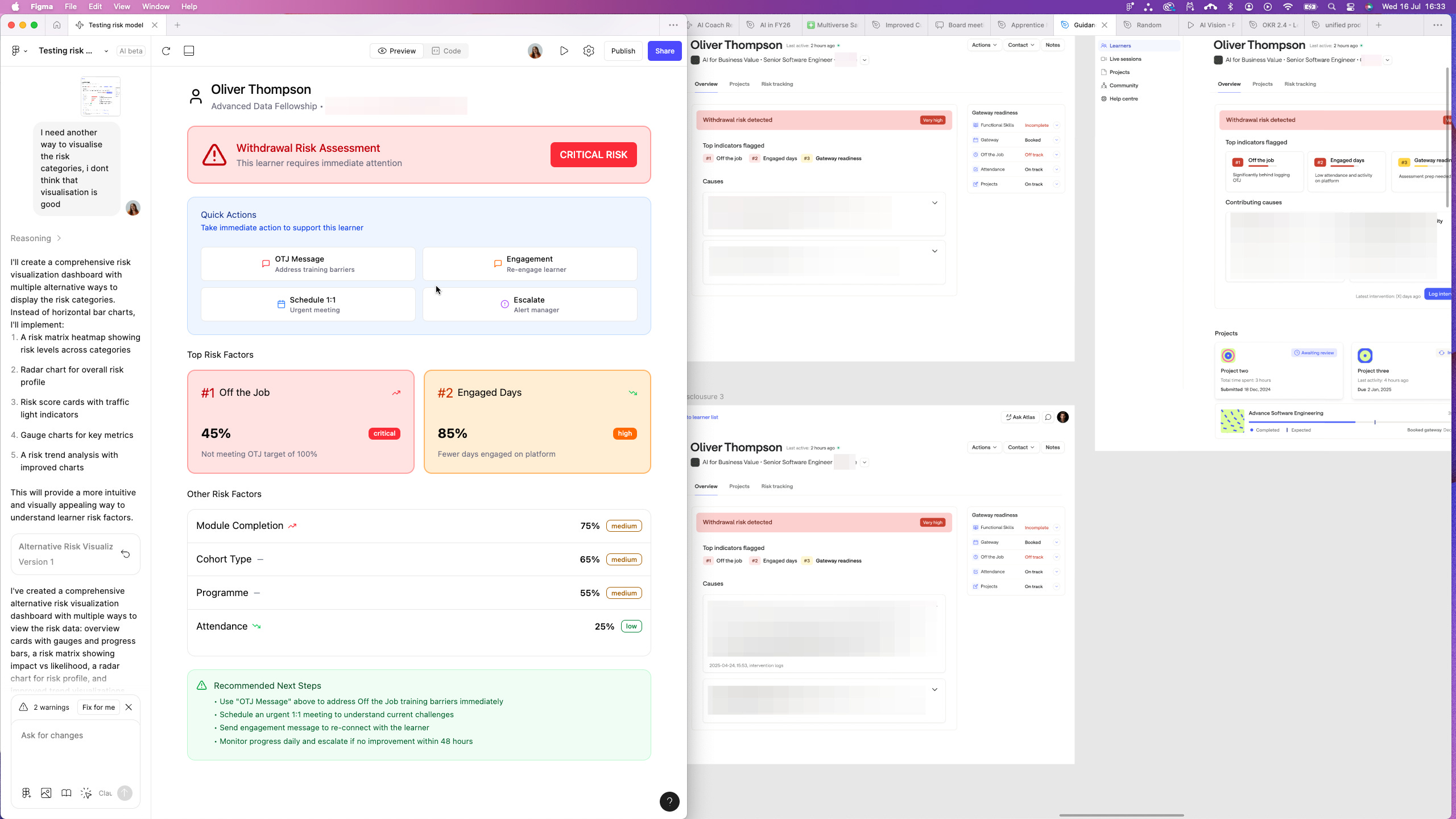
I fed Figma Make a rough design based on some old inherited designs, some logic from the way the risk model works, and the core concepts. From there I just kept going—side by side it gave me fast ideas, and although it looked horrific, it was a lot easier for me to make changes on my side than try to perfect with Make.
It meant I could go from wires to something more concrete for that PM in the space of a few hours. But not only that—I had more options than I would have had by myself.
2. Use it to buy you some time
If you’re anything like me, you can design fast, but sometimes you need to scroll the internet for ideas for a good hour or two, but often you’ve got a PM in your ear, saying they need something now for some user testing or some stakeholder review.
Be smart here, I’ve bought myself days of time using figma make mocks and even longer when it comes to delivering things to researchers.
We should and can use these rough designs to test with users. Now, up to your judgement on the level of fidelity you need for testing but if I bring us back to that example I talked about in my first little learning, I asked our researcher Tom if he could quickly test a concept that I had a hunch would land well. It wasn’t part of the core concepts we wanted to originally test so I was too busy creating a list of things that our PM Tanja wanted to get across.
I quickly mocked up something with Figma make, sent Tom the link and asked if he’d be comfortable throwing it infront of users. I was less concerned about the visuals since we were testing with our own coaches, but maybe we should all just get over ourselves in that regard. User testing should be firstly about landing concepts and UX, not seeing if they liked the shadows on the cards I was using.
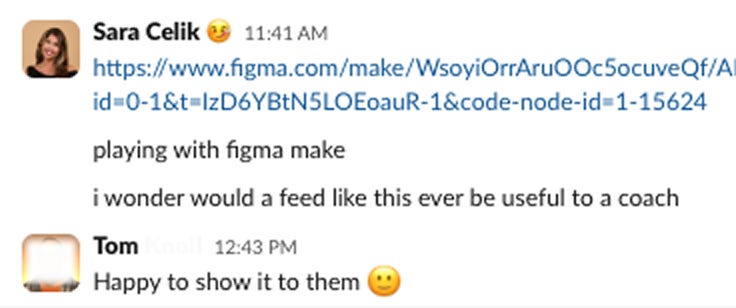
Either way, it made my realise that maybe we’ve been wasting a lot of time creating things from scratch to test. Use AI to get your core concepts across first, buying yourself some time to refine refine refine.
3. It’s really ok not to know everything, but we should probably try
I mentioned how I transitioned into a newer team at Multiverse—a team thankfully of really good friends of mine, but also a team of really annoyingly smart nerds who love AI. Our boss David has a literal PhD in machine learning, my best bud Chris is a whiz, and we have our actual ML engineer, Adam.
This meant that on every standup or discussion about a project, I was frantically side-DMing Chris asking him to explain things for me.

I often thought I should use my learning budget to buy some kind of book that I’d inevitably never read, but I decided to just throw myself into it all.
I’m still not sure I know what Langfuse is, and I usually blank when Adam and Chris start saying words I don’t recognise, but I’m also getting a lot better – better at translating a wall of text that Adam sends me from Models into some kind of half-decent designed form, better at playing with AI in my spare time, better at integrating it into my own life so I can start to understand the benefits it has. But I’m also better at educating myself little by little, finding interesting companies that I think are cool or have an interesting approach to how they talk about their AI offering.
Start with asking the silly questions, even in a side DM. Or if you have a funny but patient Danish boss like I do, no question is stupid – so just ask it.
Then maybe keep up to date with whatever the big dogs are releasing.
4. There’s no such thing as an ‘AI dEsIGNeR’
When I moved into this new role, I was excited by the opportunity to have something different on my CV. Hungry for being the best at the latest fad, I couldn’t wait to get into it all.
The reality? An AI Designer doesn’t exist. You’re just a designer. You might be translating more complex problems, or working in a new space completely, but at the end of the day, it’s just designing another rounded-corner chat box in the middle of the screen.
What I will say is I think you do need to think differently. You might need to think more broadly about the problems you’re facing, or look for more opportunities on how AI can improve things you’re working on. What you’ll funnily often find is a lot of problems don’t even need AI to fix them.
I think fundamentally what I’ve learned is that I think it’s all the same. We’re all applying shadows to the same cards—it doesn’t matter if there’s a sparkle AI emoji on it or not.
5. Look at how the world around you is interacting with AI
I think because we’re all in tech we are consumed within a world of our own nonsense. AI to us is all about agents and automation, efficiency within the company, or new and visionary product features. But how do other people—the non-techy product or eng people—interact with AI daily?
I’ve been blind, or at least not paying attention to it in the outside world much. But what I’ve noticed in the last few months is the sheer discourse about AI online in our culture, and in the physical spaces we’re in daily. It’s the TikTok girlies using ChatGPT to give themselves palm and horoscope readings, it’s the people bypassing popular calorie-tracking apps and talking to ChatGPT about what they’ve eaten today, it’s your friends at a house party on a Friday night, frantically trying to make cosmos. What once was a Google interaction has completely changed.
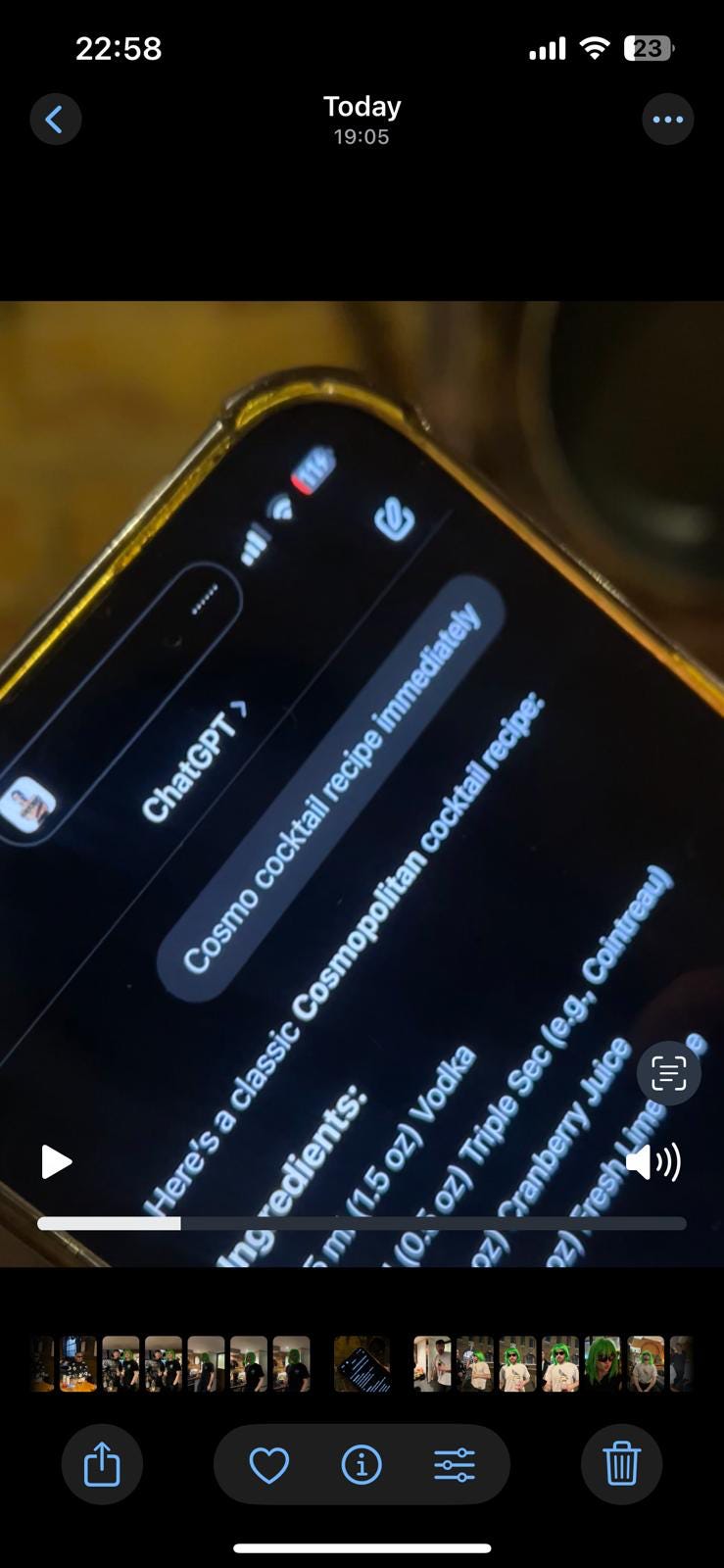
I’ve been really fascinated with coming to work and telling my work friends all the hilarious ways that my pals are using ChatGPT. Nicknamed in our friend group as ‘Chat’ and everything is ‘ask Chat quick’.
Our jobs are to design experiences for users every day, and now we have to think about how to often enhance those experiences with AI. How is everyone using AI – not just in work but for themselves? What behaviours can we pull from or learn about?
It’s not really a fully formed thought, but it’s something that I’ve been interested in observing, hoping to slowly start to bring it into my work more and more. Surely the actions and patterns of people around us can inform how we design really good AI experiences?
I think a huge part of me feels like no matter how good or clever it gets, businesses will always want people, and always want good designers – and good thinkers. One of our design leads Ken said to me today that he really thinks that AI will get better and better, especially at the UX side of things, so it’s important for us to have high visual conviction, more than we previously ever have.
Maybe that should be another learning actually?